

I’m sure you’ve heard of the word “ideologies” before; we’ve seen a few of them over the last century:
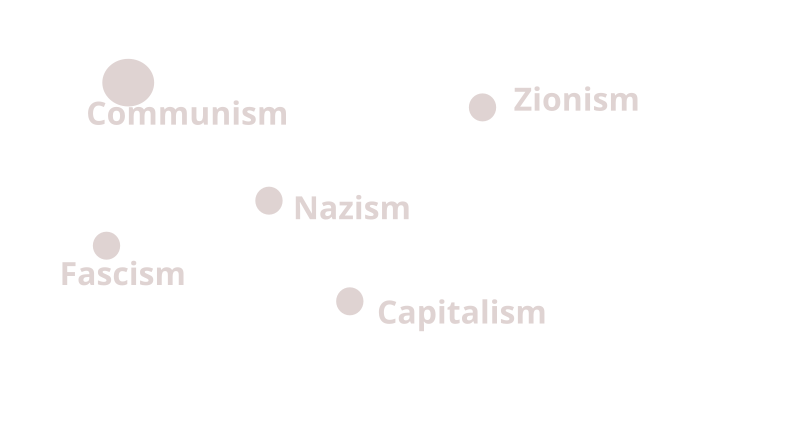
Just to give you an idea of the subject of this article: "there are ideologies", it's a term that comes up often, here's what we can refer to initially.
More precisely, it’s more or less a big “trend” that a government decides to “adopt”. Sometimes, a guy has “a big idea”, writes it down - and some people find it interesting (definitions for “ideology” varies) but this is the one we shall borrow.
Take Hitler: he wanted to do “his thing” - ultimately, the country, the government, was under the “Nazi ideology”. This is not a pro-Hitler post, I am just explaining here, what an ideology is.
Today’s Russia would be a mix of various elements and there is no clear ideology.
The USA have been on “Capitalism”. They decided to move towards a structure based on money management. Communism, on the other hand, prioritizes the "social" and "community" aspects and tends to establish a system where "everyone is together," while Capitalism creates more space relative to this degree of community solidarity. Between these two, there isn't really a better or worse option, I would say. The problem lies in other things, which I will explain in this article, but we can also note that between the idea and its implementation, there are often practical constraints. There are several variations of Communism (for example), and so on. This is one of the reasons why Communism is not “inferior” to Capitalism. It depends on its implementation.
Nazism and Zionism are ideologies with significant inherent flaws. If a government were to implement them as the guiding policy for the country's structure, these flaws would immediately become obstacles to certain healthy and natural processes. Communism and Capitalism don't really have these flaws, or at least not to such an extreme degree.
What can you expect? Some people who come to power have ideas, and after 50 years in society, some believe that Zionism or Nazism is something that will absolutely work.
As I mentioned, the real problem lies elsewhere. These few words about Nazism and Zionism touch on the real issue. Therefore, we should try to understand the problem in relation to Capitalism and Communism, because at first glance, they don't seem to have any major flaws.
I'm going to explain something that has been discovered, and you'll see how to think about it.
A hidden aspect
Historians know about ideologies quite well - but new data indicates a specific, hidden (very hidden!) phenomenon, which is [almost] always present when there are ideologies.
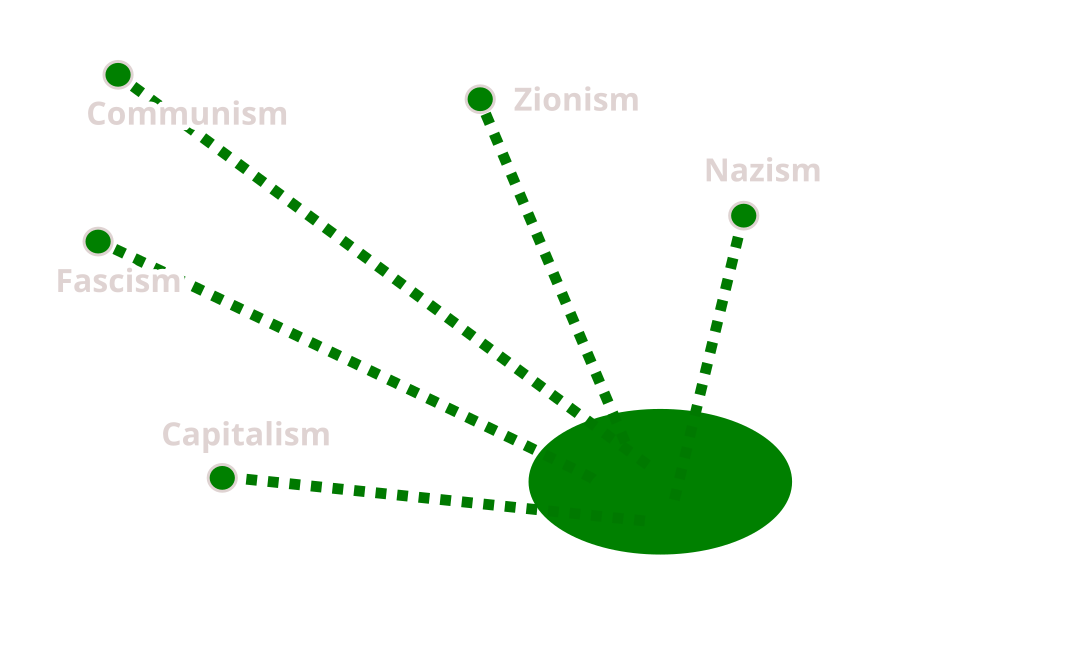
Due to a lack of data, some have called it “the fungus”. The fungus exists out there:
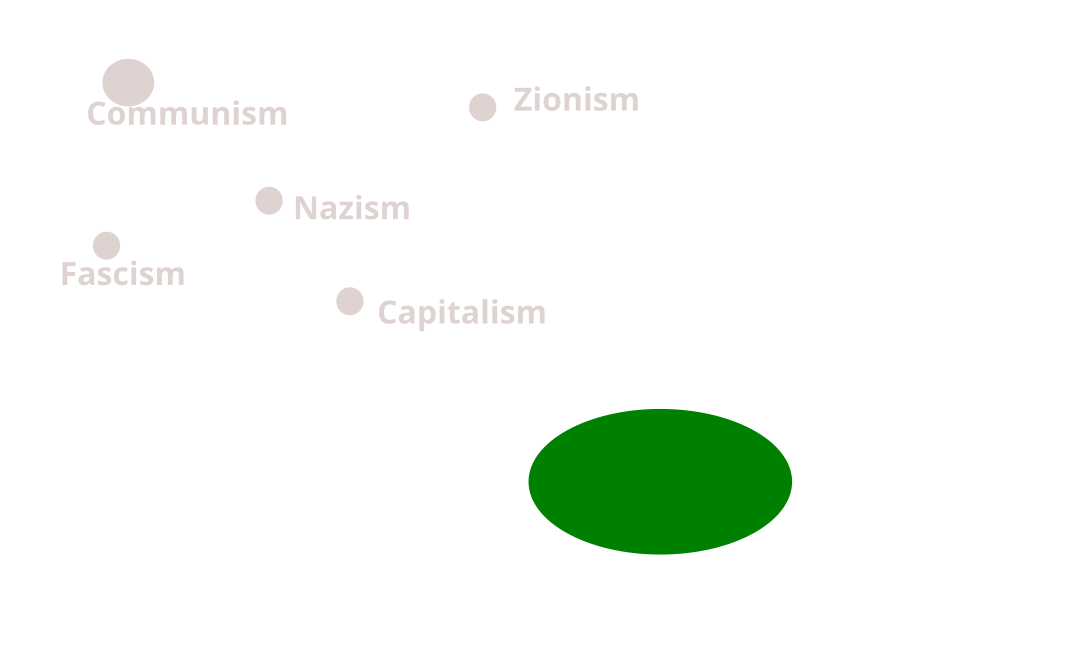
This would be a figurative idea, and I am not sure that the above is the best possible representation. Still, it gives an idea:
Basically, there is something out there that is directly related to ideologies. An entity, an influence - or if you prefer, "something" that can have an influence, something that needs to be considered, something about which we really have very little data.
What historians don’t know, didn’t know, and what they still need to know (to become history experts and really start crackin’) - is that the fungus can only “be”, trough ideologies.
I mentioned that the fungus is something related. That's not really what the fungus is, ultimately—but it's important to understand that it operates in a way that's specifically related to so-called "standard" ideologies. In that sense, we could consider the fungus an ideology in itself, etc.—the simplest approach would be to say that the fungus has its own agenda.
With these considerations in mind, here's an additional idea:
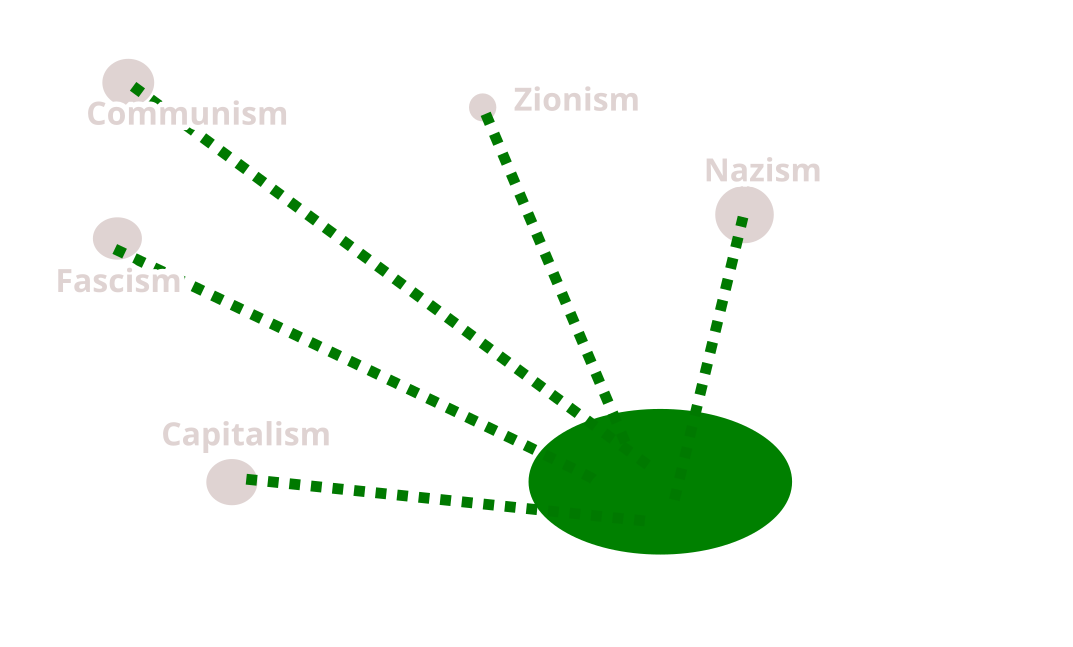
This “fungus” is a “something”, has a “mode of functionning” - and it requires “a host”; ideologies are “good” opportunities for its host-mode-of-functionning, it seems.
That is why we will have the feeling that Marxism is back - or that we identify Marxism when we stare at today’s structure.
In fact, it’s “the fungus” that which is inside.
During Stalin, nobody stopped him and Stalin had the opportunity to develop his ideas to an unlimited extent. What took place is that the fungus “stole” his movement (probably in-between: when Stalin seized power, the fungus set Stalin up, more or less) and carried on its own agenda.
Ultimately, the fungus agenda is a caricature. It amounts to mass enslavement.
Ultimately, Stalin’s last days were not about Marxism - but “pathology“, which is the essence of the fungus.
Similarly, Capitalism, arriving in the 1960’s, has been slowly invaded by the same motion. It seems that when the hijack took place, from inside, this lead the ideology towards “Neoliberalism”. Neoliberalism would be, in fact, Capitalism “infected by the fungus”. This makes sense because Neoliberalism seems to be “pathological Capitalism” - the worse for people and the best for greedy individuals.
That is why if you see Marxism, today, you see “the fungus”. That’s because that’s what was present during Stalin, which was not Marxism. Marxism acted as a first stage, but left the scene quite early.
https://luctalks.substack.com/p/how-to-read-without-getting-triggered
To give an example, those who feel alienated from the power structure of the Western world use a variety of words to convey their grievances. In the US especially, people like to call what we are living through “communism” and “Marxism.” Others, more often so in Europe, talk about “global capitalism” or “financial capitalism.”
Oftentimes, the different camps use such words to express the same, deep-rooted agony towards a system that can only be described as soul-sucking oppression of all that is True, Good, and Beautiful. And yet, “communism” and “capitalism” have an entirely different meaning as far as dictionaries are concerned.
Luctalks is clear: we are conflating Marxism with Global Capitalism (and else). There is something else.
We don’t exactly know what’s this fungus ultimately is- yeah - some know.
The fungus is "psychopathology"; that's its essence. However, it's a "relative" term and doesn't provide details about what it is. Psychopathology expresses a deviation from the initial healthy state of the mind. That's all what this word says. There's the word "pathology," which means illness, affliction. Thus, we can glimpse the context of this fungus. It’s “what afflicts the sane human mind”.
Andrew M. Lobaczewski studied "evil" and discovered that it was present at the very core of psychopathological processes.
Thus, the nature of the fungus is "evil." However, there is still a specific point to avoid misinterpretation.
The present consideration of psychopathology and evil, as the nature of the fungus, leads to the concept of psychopaths—that is, hereditary psychopathology. There are people born with psychopathological deviations. (There are, too, deviations acquired over time - “characteropathies”). Simply put, the fungus arises because of this. Psychopaths, psychopathology, psychopathies, characteropathies. But there's a crucial distinction to be made here.
Here is what Harrison Koehli, an expert in the field, says:
https://ponerology.substack.com/p/supernatural-evil-and-ponerology
… those most predisposed to receive the x signal …
Individuals with psychopathology are directly involved in the process of harm, in the formation of the “fungus” and its activation—but the process by which this occurs is indirect.
First, individuals with psychopathology are “susceptible to signal x” (the harm). They may not receive it, and therefore the fungus may not appear.
If they do receive the signal, and if the signal is not recognized for what it is, things can become problematic.
Thus, it seems incorrect to overemphasize the existence of psychopaths as the direct cause of harm, or even of the fungus. This is true, but it occurs after several steps.
Once the signal x has been received, once the fungus has appeared, individuals with severe psychopathy begin to express their deviation more forcefully. Here is an example of one of these deviations:
https://ponerology.substack.com/p/final-thoughts-on-the-persistent
Final Thoughts on the Persistent Predatory Personality
The final two chapters of Karen Mitchell’s thesis summarize her conclusions and offer some future directions for the research fields in question.
Mitchell’s PPP model posits that there is a single, overarching “dark” personality type that includes disorders and conceptualizations currently thought to be discrete phenomena. This includes psychopathy, Machiavellianism, and narcissism, which in this model are considered “partial conceptualizations” of the predatory personality.
This is more or less the context in which the fungus appears. Basically, it needs anchor points.
Martha Stout - “The Sociopath Next Door”
Most of us feel mildly guilty if we eat the last piece of cake in the kitchen, let alone what we would feel if we intentionally and methodically set about to hurt another person.
Those who have no conscience at all are a group unto themselves, whether they be homicidal tyrants or merely ruthless social snipers.
The presence or absence of conscience is a deep human division, arguably more significant than intelligence, race, or even gender.
The above two quotes would be indicative of the agenda of the fungus - hard core psychopaths, anchoring the fungus, would be the closest idea as to what the nature of the fungus is / represents.
Host / parasite / hijack
I have been hinting at one important concept: the infiltration mechanism:
Andrew M. LOBACZEWSKI - “Political ponerology”
However, no one has ever managed to identify it objectively because it would hide in one of the ideologies characteristic of the respective culture and era, developing in the very bosom of different social movements. Identification was so difficult
The initial step is a moral warping of the group’s ideational contents.
In analyzing the contamination of a group’s ideology, we note first of all an infiltration of foreign, simplistic, and doctrinaire contents, thereby depriving it of any healthy support for, and trust in, the necessity of understanding of human nature
a psychological structure is created which can be considered a counterpart or caricature of the normal structure of society or a normal societal organization
Here:
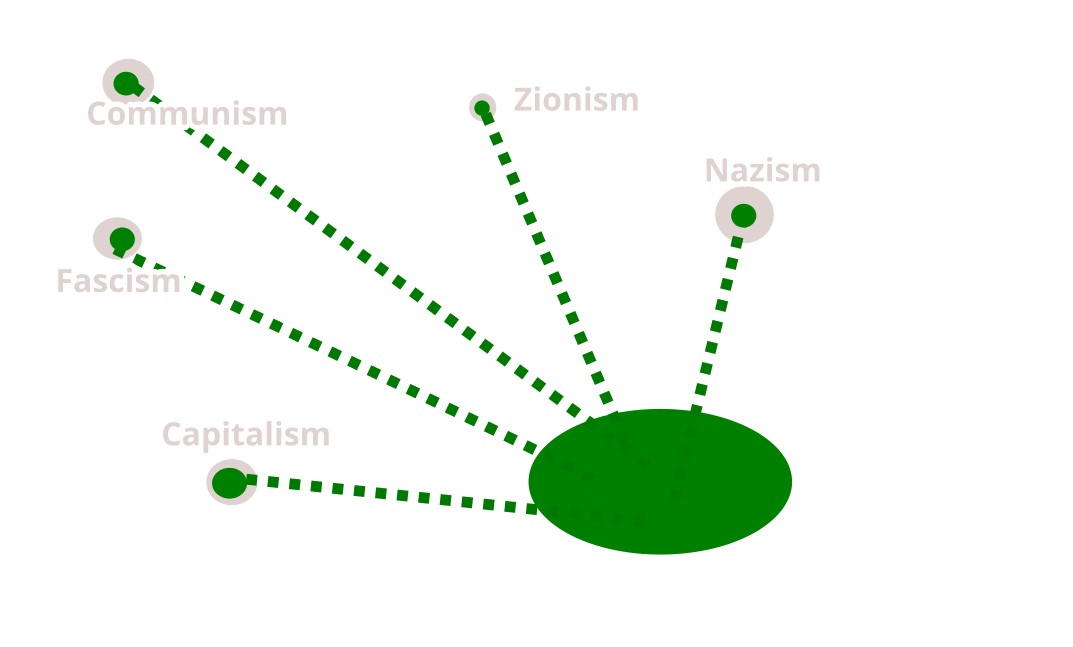
If you look at this image, you will see that I have kept a beige border around the dark green circles, and that all the circles are now the same size:
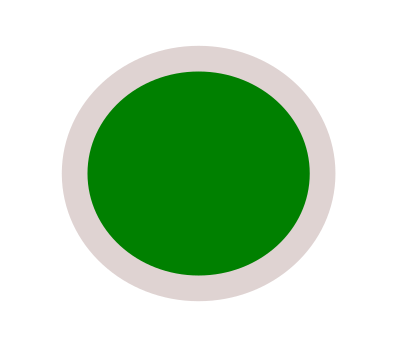
It is because the ideology has undergone a process of internal transformation that its original content has disappeared, replaced by "something else" (the fungus's agenda, its nature, which is a kind of psychopathological madness, and also "evil").
The beige border remains, for the following reason:
it has become transformed into its caricature: the name is the same, but the contents are different
… is formed by gradual adaptation of the primary ideology to functions and goals other than the original formative ones
A certain kind of layering … takes place […]. The outer layer closest to the original content is used for the group’s propaganda purposes, especially regarding the outside world
slipping a different meaning into the same names
Average people succumb to the first layer’s suggestive insinuations for a long time
All these quotes are there to indicate that a shift occurs during a long process and that when this happens, this must be taken into account:
“From this time on, using the ideological name of the movement in order to understand its essence becomes a keystone of mistakes”
To remain on the right track, here's how you should think:
Differentiating the essence of the pathological phenomenon from its contemporary ideological host is thus a basic and necessary task
Here is a summary of all this in other words:
If, in order to designate a pathological phenomenon, we accept the name furnished by the ideology of a social movement which succumbed to degenerative processes, we lose any ability to understand or evaluate that ideology and its original contents or to effect proper classification of the phenomenon, per se. This error is not semantic; it is the keystone of all other comprehension errors regarding such phenomena, rendering us intellectually helpless, and depriving us of our capacity for purposeful, practical action.
Overall, when you see “an ideology” turning its whole population into detention camps & mass murder - know that it’s not the ideology: the ideology has left the boat… It’s mainly “the agenda” of the fungus, which is operating.
That’s why Stalin, Mao, Hitler, etc etc were seemingly (and oddly) all on to the same stuff, (before they died).
A shift took place, and the fungus went “in”, and it started operating its own agenda - which would translate with detention camps against humans etc.
The problem here is that this matter seems to be no “exception”. It seems that this has been “the rule”. And, yes, we don’t know about this.
Conclusion
Andrew M. LOBACZEWSKI - “Political ponerology”
Today, however, the world is being jeopardized by a phenomenon which cannot be understood nor described by means of such a natural conceptual language
… a macrosocial phenomenon which has rendered our traditional scientific language completely deceptive
… a comprehension of the truly operational factors is beyond the ken of his natural world view
° So, first, that we don’t know of this and that we may be interested in checking a bit more about all those elements: it seems that this post of mine hints at an interesting (and potential) framework, susceptible of explaining several big things (Hitler, etc).
° Much more about the fungus here. The word “pathocracy,” is used to describe the fungus itself, and sometimes also to refer to the characteristic process of degeneration that it inflicts on the groups it infiltrates from within
(“Gosh! This ideology is suffering from a pathocracy”).
May the reader bear in mind the following: my article was intended to show that the fungus sometimes exists. Nothing more. The fungus, also called "pathocracy".
If you're interested, know that it appears after very specific stages and that this is very important. There are many stages and much knowledge about it. Therefore, I have only tried “to illustrate the fungus” here. Regarding its precise development, its laws, and so on, there is a great deal to learn.
Thanks for reading!